Eyes on the Prize
After the best training month of my career, an unexpected injury led me to adapt and rethink my off-season, without losing sight of the World Cup season I’m building toward.

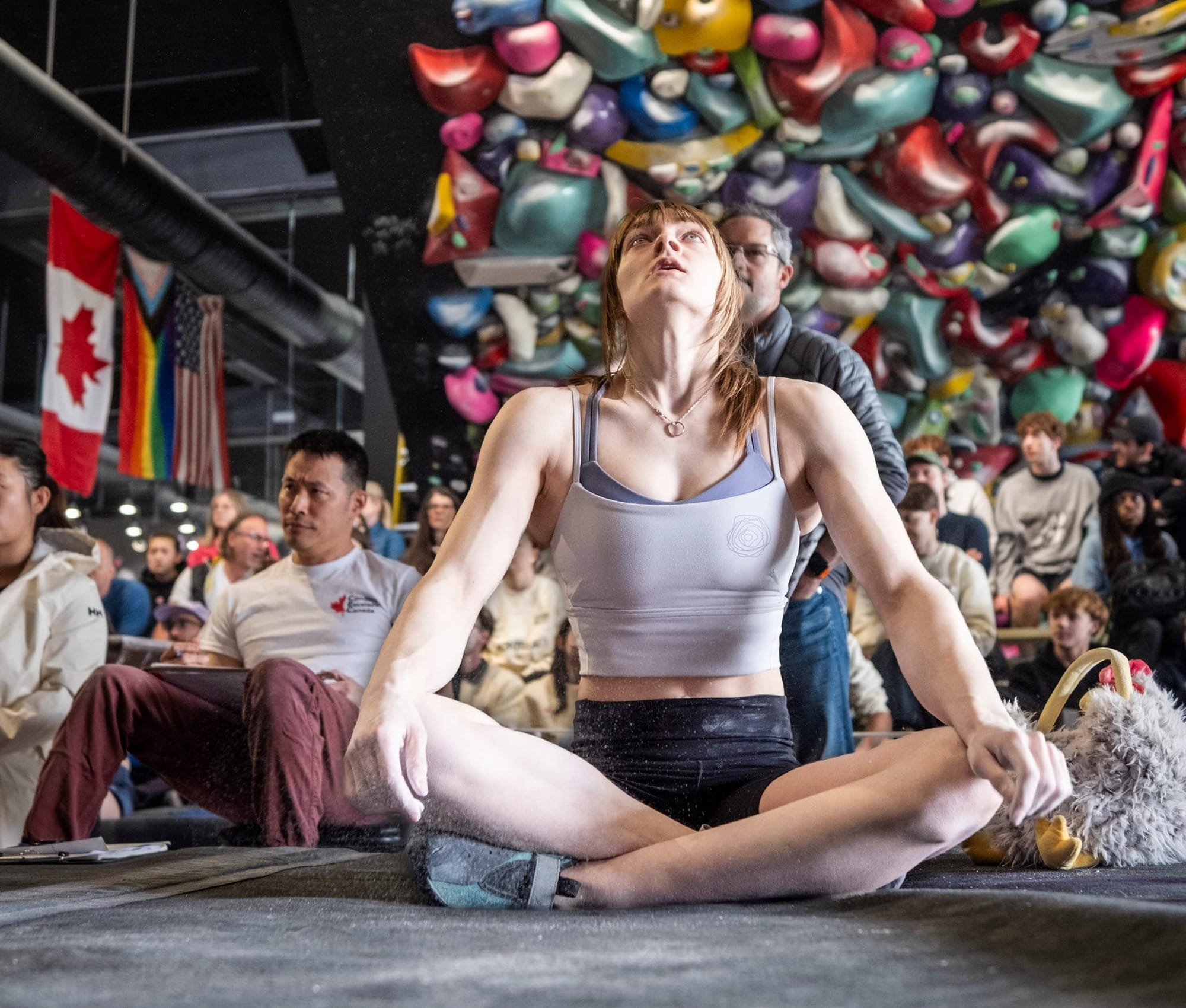
I haven’t really given an update on my training since the 2025 World Cup season ended, so here it goes.
The First Months
After the World Championships in Seoul last September, I took my annual month off. I travelled to Ontario a few times to coach the team, but overall I put my feet up and enjoyed the time off.
Around the end of October, I put my shoes back on and got back to training. This year, Zach is taking a larger role in my training and is writing my on-the-wall program, while my long-time coach Libor writes the strength and conditioning.
All of November was an excellent training month for me. Libor had me burning the candle at both ends: doing a new ashtanga yoga routine every morning before training, a short workout on rest days, and double sessions plus workouts on training days. I didn't have a day off for weeks on end, and I loved it.
Somewhere in November, amidst this marathon of training, I remember coming home and telling Zach that I had the greatest training day of my life. It was just so focused, performant, and had a touch of adversity. I tried harder than usual on every boulder in training, sent a project, and crushed every rep in the gym while nursing a cold. I got home after sunset and told Zach that that training day alone got me 1% better at climbing - for sure.
As we moved into December, the limit-bouldering phase was winding down and I only had a few more chances to send my projects before moving on for the season. Right before the end of my training cycle in mid-December, I started to notice some pain in my left forearm.
An Emerging Issue
Immediately, I thought of the boulder I did the day before. It had taken me four or five sessions to complete, and I remember the hardest move - the one that took at least twenty tries - was a big move with my left hand to an uncomfortably angled side pull above my head. When I was working on it, I can admit it was a little painful on my wrist. I didn’t identify that I was actually doing damage, though. So many positions in bouldering are uncomfortable or even painful on your wrists, you learn to ignore it. The difference here was the volume of attempts I put on this specific move that was potentially too much for my tendons this time.
When I first noticed the pain, I cut my training day short and took a rest day. Sometimes these things just need a second to calm down and I can get back to it another day. But when I got back on the wall the following day, it was still there, big time.
Zach and I thought long and hard about what this could be and chalked it up to the early stages of an overuse injury - surely my training volume just needed to go down and I needed to avoid the moves that trigger it for a while. I hated the idea of stopping completely and letting go of the incredible momentum I had in training, but I didn't have a choice. I couldn't weight the hand on overhang boulders without pain in my forearm. So instead of stopping completely, I spent a few training days climbing only on slab and modifying my workouts before taking my regularly scheduled rest week which happened to coincide around the Christmas holidays.
I'm usually relieved when my rest week comes around, but this time I was stressed. I didn't have a clear plan for healing the injury so I was crossing my fingers that the rest week would do most of the heavy lifting for me. But even at rest, I could feel the injury was still there. I could get that sharp pain with household tasks if I really wanted to. This wasn't a good sign.
What's Actually Going On?
I saw a physiotherapist in Montreal before Zach and I travelled down to Ontario for Christmas. He gave me some rehab exercises for a TFCC injury, but something didn't seem quite right.
I wasn’t confident in his diagnosis. The pain didn't show up where he said it would, and the wrist brace I was using did absolutely nothing. For a TFCC injury, a wrist brace usually helps significantly reduce symptoms by stabilizing the forearm bones. Zach had a TFCC problem a few years ago and climbed with a wrist brace daily, noting how effective it was.
Still, I did his exercises over rest week and was optimistic that things would be different when I got back to climbing.
Unfortunately, the pain felt exactly the same. I was suddenly very concerned.
At this point, Zach and I are still visiting in Ontario for Christmas, but I decided to get a second opinion right away. I couldn't waste any more time than I already did.
My second physiotherapist said it was tendonitis - definitely not TFCC - and that the load simply needed to go down until symptoms subsided. There were no exercises to follow, just advice to warm it up before climbing and be careful.
I'm glad we were making progress and ruling out TFCC, but this new approach didn’t sit right with me either. As a professional athlete, reducing training volume isn’t a neutral decision, especially in the middle of the off-season when most of my gains are made. If I’m going to step back from climbing, I need to know that I’m doing everything possible to recover efficiently - not just waiting and hoping symptoms resolve on their own.
At this point, the injury was already starting to affect my season in a meaningful way. I couldn’t return to any kind of productive training with how many holds and movement patterns I would need to avoid, and without a clear rehab plan or timeline, I wasn’t comfortable leaving something this disruptive unaddressed.
For the rest of my time in Ontario, I climbed a lot of slab, and was able to train on an adjustable kilter board, set to a modest angle. It was better than nothing, even fun at times, but in the back of my head, I needed to properly resolve this thing and get back to normal training as soon as humanly possible.
When I got back to Montreal after the holidays, I got a third opinion.
And you know what they say - third time's the charm.
What my newest physiotherapist uncovered was that a tendon in my left forearm wasn’t firing properly. The pain I’d been feeling was from another tendon picking up the slack - taking on work it was never meant to handle. The issue was triggered by repetitive stress during training. He gave me reactivation exercises, suggested load management, and sent me on my way. I took another five days off to kickstart the healing.
I was feeling better, optimistic even.
Until I wasn't.
The Setback
Over the next five days, I managed to flare up the injury significantly. I was emailing him in a panic, and he suggested I come in to see him as soon as possible.
Flaring up a tendon during a rest week, while only doing gentle reactivation exercises, felt absurd. It made me second-guess the diagnosis and left me genuinely nervous about the outlook of my season.
It would be one thing to catch an injury right at the beginning, start a strengthening program, and know that recovery will take a month or two. Instead, it felt like I wasted a month and still wasn’t on a clear path forward.
The next time I saw him, I brought Zach. Between the two of us, we would make sure we walked away with every answer to to every question we had. What exactly is injured? Am I doing the exercises correctly? Is it getting worse?
As it turns out, the flare up was mostly on me. I was treating the exercises he gave me like regular strength work. The resistance was too high, and instead of focusing on reactivating the inhibited tendon, I was just pushing through the movements.
So together, we reconfirmed the diagnosis, adjusted some of the exercises, and ended up going nearly 45 minutes over time to answer every question Zach and I had.
I felt a lot better walking out of the office that day, and I'm lucky that I had an excellent physiotherapist on my side to help me get to this point.
What's Next?
It’s been a week and a half since the flare up, and things are finally progressing on all fronts. Because Zach got the full explanation of my injury straight from the physio, he fully understands what hurts it and what doesn't. With that knowledge, he's been able to set me boulders on the spray wall that are gentle on the left hand while simultaneously hard enough to be legitimate, pre-injury level training.
It honestly feels like a small miracle.
I’ve been slowly venturing into the normal boulders at the gym, paying extra attention to the holds, wall angle, and sequences to make sure it’s okay to climb. In addition, Zach and I have maintained our slab sessions, which never hurt the tendon - even at its worst.
The slab sessions honestly got me through the first few weeks of uncertainty and fear with this injury. Becuase I was virtually free to climb whatever I wanted on slab this whole time, I've made some serious progress on this style of climbing. Slab sessions were also in the pre-injury program anyway, so I was never fully off of the program.
Overall, we’re salvaging. My training volume is a little lower than I’d like, but with Zach’s help I’m able to do my regular spray wall training (at a reduced angle), have high-quality slab sessions, and complete most of my off-the-wall training. At the same time, my tendon is starting to feel noticeably better now that I understand the exercises I’ve been given and am paying attention to the right things.
At this point, my training feels back on track, and as soon as I get the green light on my tendon, I’ll be ready to push it back to World Cup level in time for the first event in China on May 1. There's still a lot I can't do, and I have to be especially careful now more than ever, but we're getting there.
The biggest hurdle left is allowing myself to let go of what training was supposed to look like and focusing instead on building a program around what I can do right now. With a little creativity, teamwork, and support, this new program doesn’t have to be worse - it can simply be different.
Whenever I get injured, I tend to keep the end goal on my mind. When I sprained my ankle in 2022, I wore my Team Canada jacket a lot, even when I was on crutches going to the grocery store, to remind myself that I'm still a pro athlete. I'm still on the National Team. And I'm going to get back to World Cups as long as I don't give up on that goal.
This time around, I put a keychain on my backpack that's been sitting at the bottom of my bag since last May. It's a little climbing hold that I got at the Brazil World Cup in 2025. It's a reminder of how that particular World Cup felt for me. It was the first event of the season, and I just came off of a hamstring injury. It was sunny and warm, the audience was electric having never seen a Climbing World Cup on their continent before, and I was first out in the semi-final round. I had nothing to prove, everything to gain, and I climbed my absolute heart out to 11th place.
Putting myself back in that moment fills me with happiness and hope. It reminds me why I do this, and why all of the hard, frustrating, quiet work of the off-season is worth it. When training feels heavy or uncertain, thinking about World Cups helps me keep my eyes on the prize.
All this is to say…
I won’t be competing at Nationals this year.